
Comparisons
Malible vs Contentful: Which Is Best for Modern D2C Teams?

Ranjeet Kumar
19 min read
If you run marketing for a D2C brand, you already know this story. Your team can spin up a new campaign idea in an hour, yet the landing page takes weeks. You wait for design. Then for engineering. Then for QA. By the time the page goes live, the moment (and sometimes the budget) has moved on.
Headless CMS platforms were supposed to fix this by separating content from code. And the market has clearly moved in that direction, with more and more brands shifting from monolithic ecommerce platforms and page builders toward API-first, composable stacks.
But in practice, many D2C marketers still feel locked out: powerful tools, complex configs, and a lot of "ask the dev team" for even basic changes.
This is the context in which most teams compare Malible and Contentful:
Malible is a visual-first, marketer-usable headless CMS that starts from your Figma designs and turns them into structured JSON. It is evolving into an AI-powered app platform for D2C brands, with a Shopify-first approach and a strong focus on campaign speed and retention.
Contentful is an enterprise-grade headless CMS with robust APIs, a large ecosystem, and flexible content modelling, widely used as a central content hub in composable stacks.
Both are strong platforms. The real question for D2C marketers is not "Should we go headless?" It is:
Which platform actually helps my team ship campaigns faster, keep control over layouts and copy, and still play nicely with our tech stack?
From that angle, this comparison will focus less on abstract features and more on what each tool means for:
• Your speed to launch for new pages and campaigns
• Your day-to-day workflow between marketers, designers, and developers
• Your ability to scale experiments and personalization without sitting in dev queues
Malible Vs. Contentful at a Glance
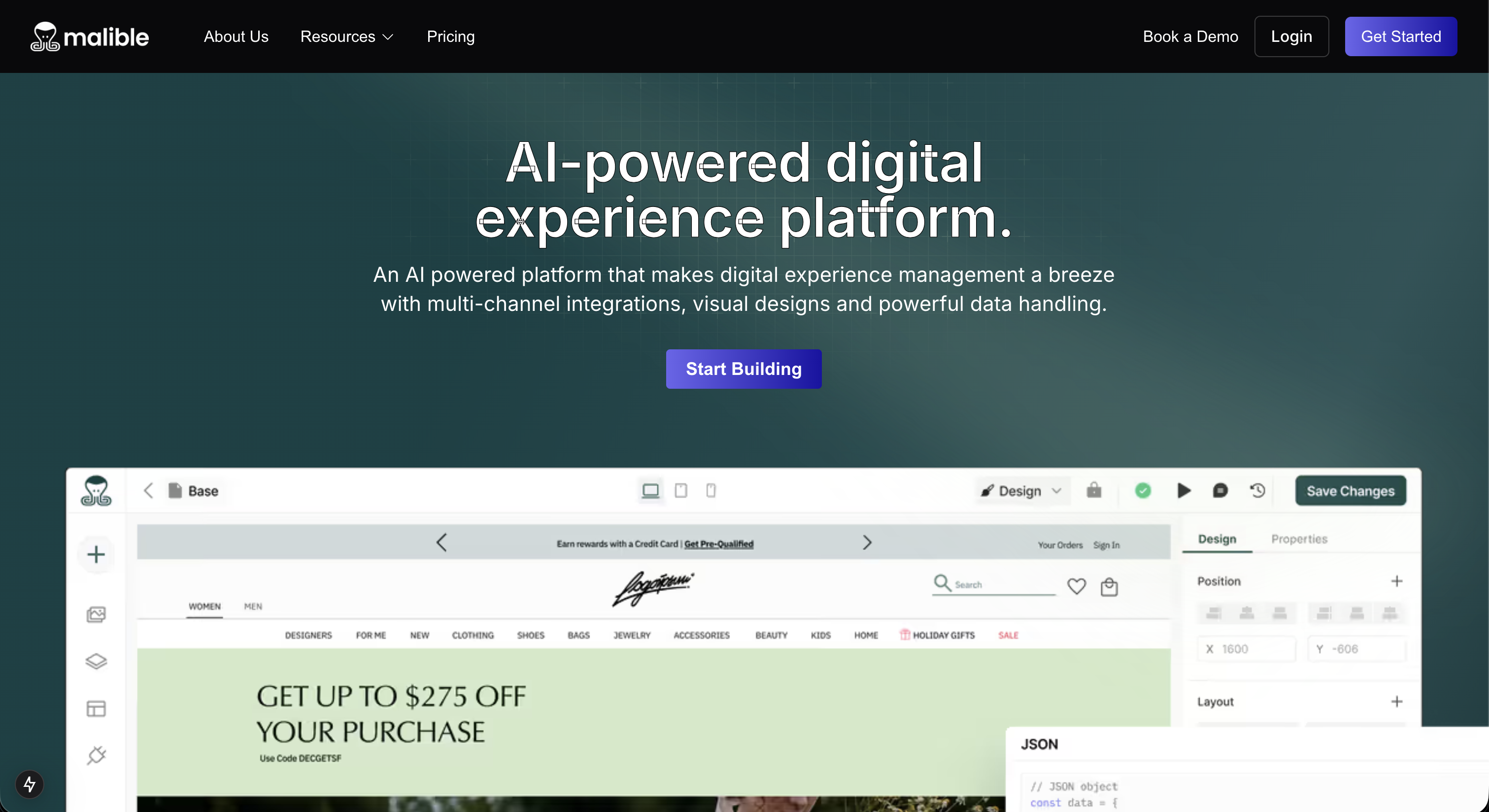
Malible is built to close the long-standing gap between how fast D2C marketers move and how slow traditional web production cycles still are. Where most CMSs start with developer-built templates, Malible starts with the design layer that is imported from full Figma files, preserving spacing, hierarchy, and components, and turning them into reusable modules that marketers can control.
Contentful, by contrast, fits best when you already have a strong engineering team owning your stack. It gives developers a lot of flexibility in how content is modeled and delivered, but this often means marketers work inside abstract content forms while the real layout logic lives in code. It is powerful, but it is not marketer-first.
Quick Comparison Table
A quick, skimmable view of how Malible and Contentful differ, especially for D2C teams that need to move fast.
| Parameter | Malible | Contentful |
|---|---|---|
| Primary User | Marketers, designers, and small dev teams working in fast-moving D2C environments | Developers, solution architects, enterprise digital experience teams |
| Best Fit Use Cases | Rapid landing pages, campaign microsites, Shopify-connected experiences, on-brand updates without dev cycles | Large multi-locale websites, complex content hubs, multi-brand governance, enterprise composable architectures |
| Ease of Use for Marketers | High. Visual-first editor, Figma-to-live components, minimal schema complexity | Medium–Low. Schema-first, abstract fields, often requires dev support to modify layouts |
| Design Fidelity | Very High as it imports full Figma files and preserves spacing, hierarchy, and components | Variable as it depends entirely on front-end implementation by developers |
| API & Integrations | REST-style JSON APIs; webhooks; dataset-driven personalization; GraphQL on roadmap; Shopify-first | Mature REST & GraphQL APIs; strong SDKs; large integration ecosystem |
| Developer Involvement Needed | Low for day-to-day changes; devs focus on initial setup and performance | High for layouts, component updates, and front-end logic |
| Pricing & TCO | Product-led SaaS; free tier; lower implementation overhead; faster time-to-value | Free + paid tiers; enterprise pricing for larger orgs; higher long-term engineering effort |
| Learning Curve | Fast and intuitive for marketers and designers | Moderate to High and comfortable for engineers, steeper for non-technical users |
This quick view reflects the core difference: Malible is designed around marketer autonomy and fast campaign velocity, while Contentful is optimized for engineering-led, multi-team enterprises.
What Each Platform Really Is
Malible: Visual-First Headless CMS for D2C Teams
Malible is a visual-first, marketer-usable headless CMS that starts from design instead of from database fields. Your team builds in Figma, and Malible converts those designs into clean JSON with components, hierarchy, and spacing preserved, so the live experience matches what the designer intended.
Under the hood, Malible is an API-first content layer. It exposes structured JSON for pages, components, and datasets via REST-style endpoints, with GraphQL and richer APIs on the roadmap as teams move into personalization and app-like experiences. The same content layer can feed a JAMstack storefront (e.g., Next.js on Vercel) and Shopify apps without heavy plumbing.
Malible is also evolving into an AI-powered app platform for D2C retention, with a Shopify-first focus. Datasets and components are designed to support:
• Personalized offers and variants
• Geo-based and cohort-based experiences
• Loyalty and post-purchase journeys
For a D2C marketer, the core promise is simple:
Your design system + Figma becomes your CMS + live experience, without going through weeks of implementation every time.
Contentful: Enterprise Headless CMS for Composable Stacks
Contentful is a mature, enterprise-grade headless CMS built to act as a central content hub in large, composable architectures. It is schema-first: teams define content types (e.g., "product," "blog post," "hero banner") with fields and references, then use APIs to deliver that content to websites, apps, in-store screens, and more.
Contentful exposes multiple APIs like delivery, preview, management, image, and GraphQL and integrates well with a broad ecosystem of tools. It shines when you:
• Operate multi-brand, multi-locale content estates
• Need strong governance, roles, and workflows
• Have a dedicated engineering team managing your front ends
For D2C marketers, Contentful is powerful but developer-centric. Most meaningful layout or experience changes still depend on developers updating front-end code and templates.
Editor Experience & Ease of Use
How Marketers Work in Malible
In Malible, marketers and designers work on a visual canvas that reflects real components, not just form fields:
• Figma sections become reusable components in the editor.
• Layout changes (hero swap, adding a section, reordering blocks) are done visually.
• Structured JSON sits under the hood, but marketers rarely have to think about it.
This makes common D2C workflows much faster:
• Landing pages for campaigns - duplicate an existing layout, tweak content and sections, publish.
• Product launches - reuse product story templates that already match your brand system.
• Fast A/B experiments - clone a page, adjust components, and point traffic via your optimization tool.
The mental model is: "What you saw in Figma is what you edit in Malible." Developers define guardrails; marketers move within them without opening tickets.
How Marketers Work in Contentful
In Contentful, marketers work primarily inside form-based content types:
• Fields like "title," "body," "CTA label," "image," and "layout type" live in structured entries.
• Pages are often composed by linking multiple entries together (e.g., hero + product grid + footer).
• The actual layout lives in the frontend code, not the CMS UI.
This is flexible and scalable, but non-technical users often experience it as:
• "I can change copy and assets, but not the way the page looks."
• "To move a section or try a very different layout, I need dev help."
For teams with strong product/engineering resources, this is acceptable. For marketer-led D2C teams, it can feel like working with the lights off.
Design Fidelity & Figma Workflow
Malible: Figma-to-Live Without Losing the Design
Malible is built around a Figma to JSON to live workflow:
• You import Figma files.
• Malible converts them into structured components and layouts.
• The spacing, hierarchy, and component structure are preserved in the CMS.
This has a few important implications for D2C brands:
• Design fidelity stays high - Your pixel-perfect launch pages look like the original Figma designs, not a loose interpretation.
• Design systems become real systems - Changes to base components can propagate consistently across pages and campaigns.
• Layout changes do not always need developers - If the component exists, marketers can rearrange and reuse it safely.
For teams that invest heavily in brand and creative, this matters. You are not re-building designs twice, it is once in Figma, then again in code.
Contentful: Traditional Hand-Off from Design to Code
With Contentful, the workflow is closer to the classic pattern:
• Designers create layouts in Figma.
• Developers interpret those designs and implement components and templates in the front end.
• Content editors fill in fields in Contentful that map to those templates.
This is a proven process for many organizations, but:
• Design intent is mediated by engineering.
• Every major layout change usually means another dev cycle.
• Marketers control content and some options, but not the true structure.
If your priority is brand-safe, design-true pages that marketers can adjust without waiting, Malible has a clear edge.
API Architecture & Integrations
Malible: Simple, D2C-Oriented APIs
Malible exposes:
• REST-style JSON APIs for pages, components, and datasets
• Webhooks for reacting to content changes
• Datasets that power offers, segments, and personalized blocks
• A GraphQL and advanced API roadmap for deeper personalization and app use cases
Integration priorities match a typical D2C stack:
• Shopify and ecommerce
• React/Next.js storefronts
• Analytics, CRM, and automation tools
The focus is not on offering every API pattern under the sun, but on reducing complexity for standard D2C architectures, so your developers can connect once and keep moving.
Contentful: Broad, Enterprise-Grade API Surface
Contentful provides:
• Multiple REST delivery and management APIs
• A GraphQL Content API
• Image, preview, and environment management APIs
• SDKs in many languages and a large integration marketplace
For teams with complex integration landscapes such as internal tools, multiple front ends, middleware, and data pipelines, this is a big advantage. You can plug Contentful into almost anything.
The trade-off: to fully benefit from this flexibility, you typically need heavier engineering involvement and more up-front architecture work.
Workflow, Collaboration & Speed to Launch
Malible: Shrinking Handoff Bottlenecks
Malible's core design assumption is that handoffs are the bottleneck in D2C web production. It optimizes for:
• Marketers editing content and layouts on a visual canvas
• Designers working directly from their Figma system
• Developers wiring the front end once and then focusing on performance and custom logic
As a result:
• Time-to-first-launch for a new MVP site or campaign page can drop from weeks to days or even under 24 hours for simple flows.
• Iterative changes (copy tweaks, section swaps, new variants) stay in marketing's world.
Workflow features are evolving, but the direction is clear: parallel work instead of linear "brief to design to dev to QA to launch" loops.
Contentful: Strong Governance, Slower Change Cycles
Contentful excels at structured workflows and governance, especially in larger organizations:
• Roles, permissions, and environments keep content safe.
• Workflows and approvals fit complex teams and agencies.
• Editorial teams can manage large content estates across sites and locales.
However, because layout and logic live in front-end code, meaningful changes still often require:
• A dev ticket
• A sprint slot
• QA and deployment
For a global enterprise, this is normal and acceptable. For a 10 to 20 person D2C team trying to ship 2 to 3 campaigns a month, it can be the difference between catching a trend and missing it.
Pricing & Total Cost of Ownership
Malible: Time-to-Value and Fewer Dev Cycles
Malible follows a product-led growth model:
• A free tier designed to help teams launch a first site or campaign quickly
• Paid plans priced below heavy enterprise CMS contracts
• Emphasis on reducing dev hours and compressing launch timelines
The TCO story for a D2C brand is less about seats and environments and more about:
• How many developer hours you save per quarter
• How many campaigns and experiments you can actually ship
• How often you avoid "we'll do it next sprint" for simple changes
Because Malible is visual-first and marketer-usable, a large chunk of costs tied to repeated implementation work (Figma to templates to CMS wiring) are reduced or removed.
Contentful: Flexible Plans with Higher Engineering Overhead
Contentful offers:
• A free plan for small projects and testing
• A mid-tier plan in the low hundreds of dollars per month
• Enterprise plans that scale with usage, locales, environments, and API volume
The platform itself is reasonably priced for what it offers, but the true TCO often includes:
• Ongoing engineering to maintain and evolve templates
• Integration work with other systems
• Governance and process overhead for multi-team environments
For big organizations, this is justified. For D2C teams primarily fighting for speed and autonomy, Malible's model will often feel leaner and more aligned with reality.
Scalability, Security & Reliability
Malible: Modern Architecture, Early in Its Public Story
Malible is architected for:
• JAMstack-style front ends (e.g., Next.js on Vercel or Netlify)
• Cached API responses and ISR/static rendering by default
• Separation of content, layout, and business logic
This makes it "fast by design" and suitable for growing D2C brands. As a newer platform, its security and scale story is still being built in public, but you can expect:
• Secure APIs and role-based access
• A SaaS model that evolves with customer needs
• Direct access to the product team during early stages
For many D2C teams, this trade-off is acceptable—especially for non-regulated contexts where they can pilot, learn, and scale progressively.
Contentful: Enterprise Credentials and Proven Scale
Contentful is a known quantity in enterprise environments:
• Global CDNs for content delivery
• Tiered SLAs and uptime commitments on higher plans
• Enterprise security and governance features (SSO, granular roles, etc.)
If your organization already has strict security, compliance, or SLA requirements, Contentful is easier to push through internal review today.
For most mid-market D2C brands, both platforms will handle current traffic just fine. The main difference is whether you prioritize enterprise-grade assurances now, or are comfortable trading some of that for greater marketer autonomy and velocity with Malible.
In short:
If you want a visual-first, Figma-true, marketer-usable headless CMS that accelerates campaigns, Malible is built for you.
If you run a complex, developer-led, multi-brand content estate, Contentful's enterprise headless model remains a strong, battle-tested option.
How Malible vs Contentful Feel in Real Life: 3 D2C Scenarios
Sometimes the fastest way to decide is to see how each platform fits into a day-in-the-life scenario. Below are three realistic setups we see often with D2C brands—and how Malible and Contentful tend to feel in each.
1. A 10-Person Growth Team at a D2C Skincare Brand
The situation:
• You are a lean team selling skincare direct-to-consumer.
• You run 2 to 3 campaigns a month across paid social, email, and influencers.
• Your site is built on Shopify + a modern frontend.
• You have one part-time developer or an agency you share with other priorities.
Your biggest pains:
• Landing pages for promos and product drops take weeks instead of days.
• Simple layout changes (new hero, swapping sections, adding social proof) require dev tickets.
• Figma designs are beautiful, but by the time they are implemented, the campaign window is almost over.
How Malible fits
With Malible, this team:
• Imports its Figma launch templates once, converting them into reusable components in the CMS.
• Let marketers and designers clone, tweak, and publish new campaign pages directly from a visual canvas.
• Uses datasets to manage offers, bundles, and seasonal variations without touching code.
Day to day, the workflow feels like:
"We brief and design on Monday, have a working page on Tuesday, and start driving traffic by mid-week."
The developer focuses on performance, tracking, and Shopify integrations, not on repeated layout work.
For this scenario, Malible is the more natural fit. It is built to shrink handoff loops and turn your Figma system into a repeatable campaign engine.
How Contentful fits
Contentful can absolutely power this brand, but the experience is different:
• The developer or agency sets up content types and templates and wires them to your frontend.
• Marketers update fields and assets inside Contentful but rely on devs for structural or layout changes.
• New page types or significantly different layouts often mean another implementation cycle.
For a small team with limited engineering capacity, Contentful is powerful but can feel heavier than needed. It shines when that same team grows into a larger, more structured digital organization.
2. A Mid-Market Fashion Brand Scaling Paid Social & Creators
The situation:
• You are a growing fashion label doing:
• High-volume paid social testing (creatives, hooks, and offers).
• Landing pages keyed to specific influencers, collections, or drops.
• Frequent merch refreshes and time-bound bundles.
Your pains:
• You want many variations of similar pages for testing, but every new variant feels like a "project."
• Your brand team cares deeply about design consistency, but small deviations creep in when pages are reimplemented repeatedly.
• You struggle to tie performance data back to page structures, making it hard to know which layouts actually work.
How Malible fits
Malible gives this team:
• A Figma-true component library inside the CMS, so every page variant uses on-brand building blocks.
• The ability for marketers to create multiple versions of the same layout with different hooks, hero blocks, social proof without calling engineering.
• A structured content model that makes it easier to correlate page layouts with performance metrics.
In practice, it feels like:
• "We keep the design system tight while letting growth test aggressively."
• "We can launch and iterate new pages as fast as we ship ads."
For this brand, Malible's visual-first, component-based approach aligns directly with the testing cadence and design sensitivity of fashion D2C.
How Contentful fits
Contentful works well if:
• You are ready to invest in a strongly modeled content system.
• Your dev team creates a robust set of templates and components for experimentation.
However, experimentation depends on:
• How many templates can your engineers feasibly support?
• How quickly can those templates be adjusted when a new creative or layout idea appears?
Contentful is the right choice if your testing program is run by a product/engineering organization. If it is driven primarily by marketing and creative, Malible will likely feel more direct and less bottlenecked.
3. A Global Retail Enterprise with Multiple Brands and In-House Engineering
The situation:
• You operate:
• Several brands across regions with shared infrastructure.
• A central digital experience team with engineers, architects, and platform owners.
• Many channels: web, apps, in-store displays, partner sites, and more.
Your pains are different:
• You need a single source of truth for content across brands and countries.
• Governance, permissions, locales, and compliance matter as much as campaign speed.
• There are multiple internal consumers of content: marketing, product, retail operations, and regional teams.
How Contentful fits
This is where Contentful often shines:
• It acts as a central content hub feeding many channels and endpoints.
• Complex content models, locales, and environments can be designed to match your organization.
• Enterprise features like roles, workflows, SSO, SLAs, and marketplace integrations that support a large internal ecosystem.
In this setup, it makes sense that:
• A platform or engineering team owns the CMS.
• Downstream teams consume structured content through apps, sites, and services.
For this kind of enterprise, Contentful is a strong, battle-tested choice. Malible can still play a role, but more as a specialized layer for D2C experiences and campaigns rather than the central content backbone.
How Malible fits
Malible is most useful here when:
• One or more of your brands runs direct-to-consumer programs that need more speed and autonomy than the global platform can provide.
• You want a lighter-weight, marketer-led layer for campaign sites, product drops, or loyalty journeys, while leaving the core enterprise content hub in place.
In practice, that can look like:
• Keeping Contentful as the global system of record, and using Malible as a D2C experience layer for specific brands or regions.
• Letting local or digital-first teams move faster without conflicting with central governance.
Choose Contentful If or Choose Malible If
Choose Contentful if:
• You already operate a mature composable stack with product, engineering, and platform teams who own content modeling, deployments, and integrations.
• You have a strong in-house dev team or a long-term agency, and most structural changes to your frontend naturally move through sprints.
• You need a central content hub that serves many channels—web, mobile apps, in-store displays, partner feeds, and internal tools.
• You manage multiple brands, locales, or regions, and governance, permissions, and versioning are non-negotiable.
• You value enterprise ecosystem depth, SLAs, and third-party integrations more than pure editor simplicity.
• Your marketers primarily update fields and assets, and layout decisions are meant to stay with developers and designers.
Contentful is a proven enterprise CMS. If your working model is developer-led and your complexity is multi-brand or multi-channel, it fits naturally and scales predictably.
Choose Malible if:
• You are a D2C brand prioritizing speed-to-launch, testing agility, and campaign velocity over heavy governance.
• Your marketing team wants direct control over pages, layouts, and content without opening dev tickets for every swap, variant, or new section.
• Your brand lives in Figma, and you want that design system to translate cleanly into production without repeated implementation work.
• You care about preserving design fidelity, so the live site looks exactly like the creative without back-and-forth alignment cycles.
• You want a visual-first headless CMS that blends creativity and structure—Figma components → structured JSON → live pages.
• You want fewer dependencies on engineering, so developers can focus on core logic, performance, and integrations, not constant layout updates.
• You want a CMS that is evolving into an AI-powered D2C app platform, especially if retention, personalization, and Shopify-connected experiences are part of your roadmap.
• You want lower TCO, faster onboarding, and the ability to get a new campaign live in under a day.
For D2C marketers and growth teams, Malible tends to feel like a natural extension of how you already plan, design, and ship campaigns—just without the bottlenecks.
Final Thoughts: Which Platform Should You Choose?
Both platforms are strong, this isn't a "good vs bad" comparison. It's a fit comparison, and the difference comes down to how your team works today and what slows you down the most.
If your organization is developer-led, with complex multi-channel needs and established governance, Contentful will serve you well.
If your organization is marketer-led, shipping fast campaigns, relying heavily on Figma, and needing autonomy from dev cycles, Malible will almost certainly feel smoother, faster, and more aligned with your workflow.
Ready to See Malible in Action?
If you want to experience the difference firsthand, here are the easiest next steps:
• Book a quick demo and see how your current workflow would look inside Malible.
• Import your existing designs from Figma to turn your components into live, editable JSON in minutes.
• Spin up a free workspace and launch a simple campaign page and feel the speed gains for yourself.
Modern D2C teams move fast. Your CMS should, too.