
E-Commerce
What Most E-Commerce Brands Overlook About CMS Architecture (Until It Slows Down Their Growth)

Ranjeet Kumar
4 min read

In the early days of e-commerce, static content models were enough. A handful of products, fixed templates, and infrequent updates.
Today, that architecture is a liability.
E-commerce brands now operate in real-time cycles: dynamic merchandising, continuous UX experiments, and omnichannel launches.
Scaling SKU catalogs, personalizing experiences, or even running a limited-time offer across platforms shouldn't require database workarounds or urgent code deployments, yet it often does.
The root cause?
Legacy CMS architectures that hardwire content to presentation, offer rigid data structures, and make content delivery an afterthought instead of a strategic layer.
As the digital landscape evolves, the demand for AI-first CMS platforms and AI-powered digital experience platforms is reshaping expectations.
Brands need systems that aren't just flexible and modular, but also intelligent, adaptive, and ready to integrate AI-driven personalization, content automation, and real-time data insights at the core.
Let's dive into why flexible, modular, API-first CMS designs — powered by AI-enhanced digital experiences — have become non-negotiable for serious e-commerce operations, and how rethinking your content infrastructure could lead to measurable business performance.
The New Requirements for Modern E-commerce Content Management
Most content management systems face one of two inherent challenges:
1. Decoupled Architecture for Agility
Traditional CMS platforms bundle the front-end and back-end together, making any change, even as small as updating a promotional banner, risky and time-consuming.
Modern e-commerce demands a decoupled (or headless) approach, where content lives independently from presentation layers.
This architecture allows business teams to iterate faster without waiting on dev sprints.
Developers, meanwhile, can innovate front-end experiences (mobile apps, progressive web apps, marketplaces) without content bottlenecks
2. Modular Content Modeling for Scale
Scaling from 100 SKUs to 10,000 SKUs isn't just a database problem; it's a content structure problem.
Brands need CMS systems that support modular content models: reusable blocks for product descriptions, shipping policies, legal disclaimers, and marketing highlights.
Flexible schemas mean you can update content globally across thousands of products with a single change, instead of touching each page manually.
3. Built-In Experimentation Capabilities
In e-commerce, micro-optimizations add up: moving a "Buy Now" button, tweaking product image layouts, and testing new promotional copy.
Traditional CMS platforms rarely support this natively, forcing marketers to depend on third-party tools or hacky workarounds.
An ideal CMS for e-commerce enables A/B testing, personalization experiments, and iterative content deployments without creating multiple page versions or overburdening the dev team.
4. API-First Design for Omnichannel Delivery
In e-commerce, micro-optimizations add up: moving a "Buy Now" button, tweaking product image layouts, and testing new promotional copy.
Traditional CMS platforms rarely support this natively, forcing marketers to depend on third-party tools or hacky workarounds.
An ideal CMS for e-commerce enables A/B testing, personalization experiments, and iterative content deployments without creating multiple page versions or overburdening the dev team.
5. AI-First Evolution for Intelligent Experiences
The next generation of e-commerce isn't just about displaying content, it's about dynamically adapting content based on user behavior, preferences, and real-time feedback.
Platforms like Malible are building toward an AI-first CMS platform future, where:
• Dynamic personalization engines recommend products based on behavior patterns
• Generative AI tools help teams create, localize, and optimize product content faster
• Predictive analytics guide merchandising and promotional strategies
• AI-driven workflows automate mundane tasks like content tagging and performance monitoring
E-commerce brands that adopt AI-first CMS architectures will have a major advantage: faster iteration cycles, deeper personalization, and operational efficiency that directly translates to revenue growth.
Rethinking CMS Infrastructure: A Strategic Imperative
If your current CMS still treats content as static, manually updated, and tightly coupled to presentation, it's not just slowing you down… it's actively costing you revenue.
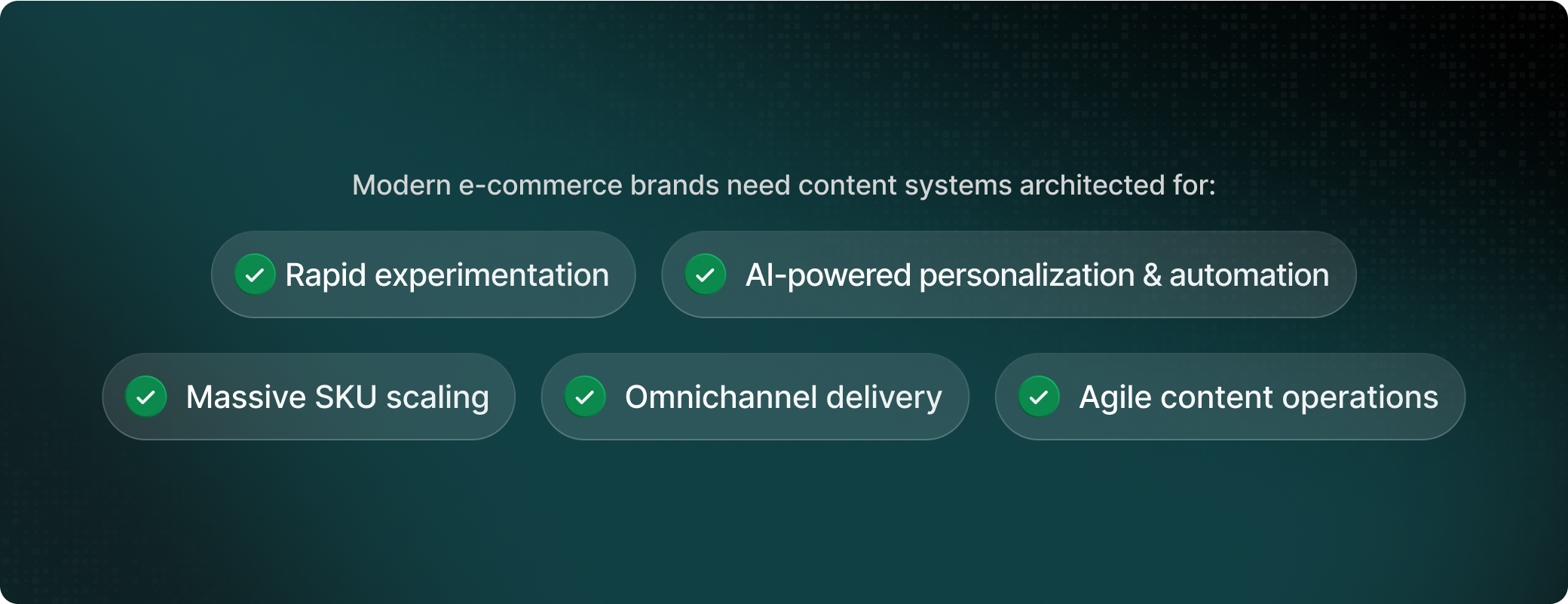
Malible's shift toward an AI-first Digital Experience Platform is not just about adding AI features, it's about reimagining the entire foundation of how content is created, delivered, adapted, and optimized in the modern commerce ecosystem.
In the next era of e-commerce, it won't just be about who has the best products.
It'll be who moves faster, experiments smarter, and personalizes deeper, at scale.
And that starts with the right CMS architecture.

Schedule a Call
Experience the difference a truly user-centered CMS can make. Schedule a Malible demo today and see why teams actually prefer working with us.